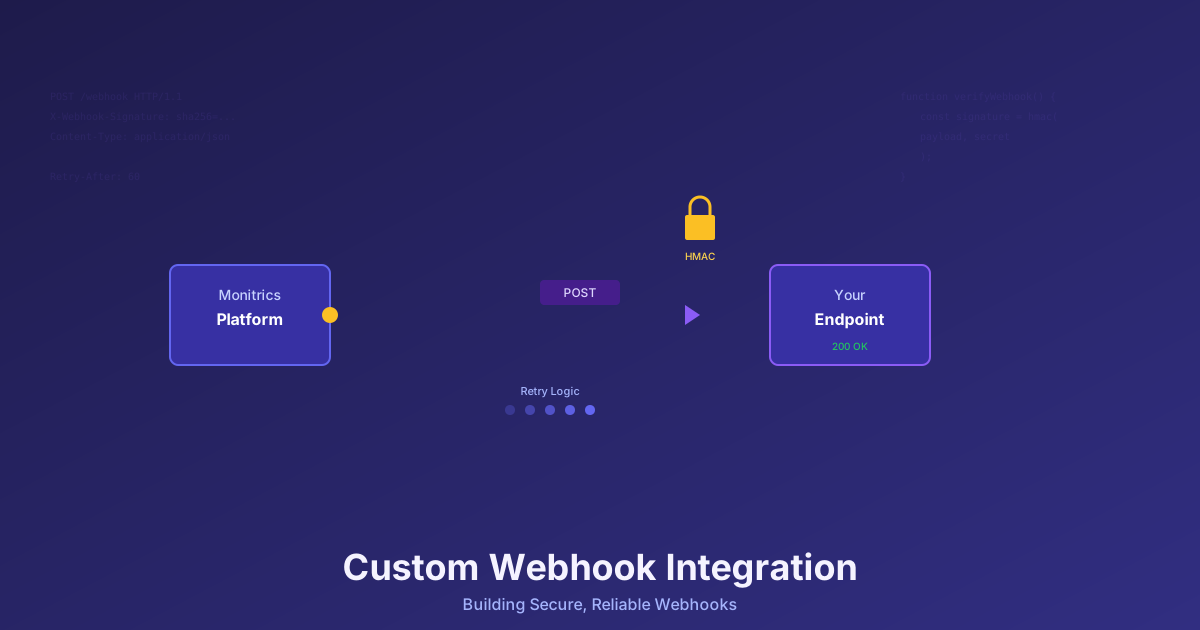
Building a Custom Webhook Integration for Your Monitoring Stack
Learn to build secure, reliable webhook integrations for your monitoring platform. Authentication, retry logic, payload formats, and production-ready patterns.
Building a Custom Webhook Integration for Your Monitoring Stack
Published: February 2026 | Reading Time: 10 minutes
Your monitoring platform needs to notify a custom CRM when critical alerts fire. The vendor doesn't provide a native integration. You need to build a webhook receiver—but how do you make it secure, reliable, and maintainable?
Webhooks are deceptively simple on the surface: an HTTP POST request with a JSON payload. But production-ready webhook integrations require careful attention to authentication, retry logic, and failure handling. Let's walk through the patterns that separate toy implementations from systems you can depend on.
The Security Foundation
Webhooks create an endpoint that accepts incoming HTTP requests from the internet. This is inherently dangerous. Without proper authentication, anyone who discovers your endpoint can send fake alerts, trigger false incidents, or probe your infrastructure for vulnerabilities.
HMAC signature verification is the industry standard for webhook security. The sending system (your monitoring platform) generates a cryptographic signature using a shared secret and the message payload. This signature travels with the request in a header. Your receiving system recalculates the signature using the same secret and payload—if the signatures match, the request is authentic.
The beauty of HMAC is that it validates both authenticity and integrity. An attacker can't generate valid signatures without the secret, and they can't modify the payload without invalidating the signature. Unlike API keys, which just prove identity, HMAC proves the message content hasn't been tampered with.
Implementing HMAC verification requires attention to detail. Always use constant-time comparison when checking signatures to prevent timing attacks. Include a timestamp in the signature calculation and reject requests with timestamps more than a few minutes old—this prevents replay attacks where an attacker captures a valid request and resends it later.
Here's the core pattern: when a webhook arrives, extract the signature from the header and the timestamp from either a header or the payload. Verify the timestamp is within your tolerance window. Concatenate the timestamp and payload body, calculate the expected signature using your shared secret, and compare signatures. Only process the webhook if everything matches.
Beyond HMAC, enforce HTTPS exclusively. A valid signature means nothing if an attacker can read the payload in transit. Never accept webhooks over unencrypted HTTP, regardless of what testing convenience it might provide.
Payload Design That Scales
The structure of your webhook payload matters more than it might seem initially. A well-designed payload makes integration straightforward; a poorly designed one creates ongoing maintenance burden.
CloudEvents has emerged as the standard specification for event data. Its required fields—spec version, event type, source, ID, and timestamp—provide consistent metadata that receiving systems can rely on. The actual event data goes in a nested object, keeping business logic separate from transport concerns.
Even if you don't formally adopt CloudEvents, its principles apply. Every webhook should include a unique event ID for deduplication, a timestamp for ordering, a type indicator so receivers can route different events differently, and sufficient context to understand the event without querying external systems.
For monitoring alerts specifically, include everything needed to understand and respond to the alert. The alert severity, the affected resource, the metric that triggered it, current and threshold values, links to relevant dashboards or runbooks—all this context eliminates round trips and speeds incident response.
Be thoughtful about payload size. Massive payloads increase latency, consume bandwidth, and may exceed receiver limits. If an event truly requires extensive data, consider including a summary in the webhook with a link to fetch full details.
Retry Logic That Actually Works
Networks fail. Servers restart. Receivers have bugs. A webhook that fires once and gives up on failure will lose events, which for monitoring systems means missed alerts and delayed incident response.
Exponential backoff with jitter is the standard pattern for webhook retries. The first retry happens after a short delay—perhaps one second. Each subsequent retry doubles the wait: 2 seconds, 4 seconds, 8 seconds, 16 seconds. This prevents overwhelming a struggling receiver while ensuring eventual delivery.
Jitter adds randomness to retry timing. Without jitter, if a receiver goes down and affects thousands of senders, they all retry at exactly the same times, creating synchronized traffic spikes that may prevent recovery. Adding random variation spreads the load.
Set reasonable limits. Retrying indefinitely wastes resources and creates operational confusion when old events finally arrive. Industry practice varies—Stripe retries for about three days, GitHub for about six hours—but the principle is consistent: retry long enough to survive temporary outages, then give up and handle the failure differently.
Dead letter queues handle webhooks that exhaust all retries. Rather than losing the event entirely, move it to a holding area for manual inspection. Operations teams can review failed webhooks, diagnose the underlying problem, and replay them after fixing the receiver. This transforms "lost event" into "delayed event," which is dramatically better for reliability-critical systems.
Make retry decisions based on response codes. A 2xx response means success—stop retrying. A 4xx response (except 408 Request Timeout and 429 Too Many Requests) typically indicates a problem with the webhook itself that retrying won't fix—malformed payload, authentication failure, resource not found. Retrying these wastes resources. 5xx responses and network failures are retry-worthy; the problem is likely temporary.
Rate Limiting and Backpressure
Webhook receivers need protection from senders that generate too many events. Whether from a legitimate traffic spike or a misconfigured sender, overwhelming volume can degrade or crash receiving systems.
Implement rate limiting per webhook source. Track how many requests each sender has made in the current window, and reject requests that exceed the limit with a 429 Too Many Requests response. Include a Retry-After header indicating how long the sender should wait before trying again.
The token bucket algorithm handles both sustained load and occasional bursts gracefully. A "bucket" fills with tokens at a constant rate, and each request consumes a token. If the bucket is empty, requests are rejected. The bucket size determines burst capacity; the fill rate determines sustained throughput. This allows occasional traffic spikes while preventing sustained overload.
For senders, respect backpressure signals. When you receive 429 responses, slow down. When a receiver is consistently slow, reduce sending rate rather than queuing indefinitely. Circuit breakers prevent cascade failures—if a receiver is failing repeatedly, stop sending temporarily rather than piling up failures.
Building Resilient Receivers
Your webhook receiver is a public-facing service that must handle malicious input, malformed data, and unexpected patterns. Defensive design is essential.
Parse input carefully. Validate that the content type matches expectations. Limit payload size to prevent memory exhaustion. Catch and handle parsing errors gracefully—a malformed payload shouldn't crash your service.
Process webhooks asynchronously when possible. Accept the webhook, validate authentication, return 200 OK, and then process the payload in a background job. This keeps response times fast (reducing timeout issues) and provides natural retry capability if processing fails.
Implement idempotency using the event ID. Track which events you've already processed, and skip duplicates. Webhook senders may retry successful deliveries if they don't receive the acknowledgment, or network issues may cause duplicate POSTs. Your receiver should handle this gracefully rather than processing the same event multiple times.
Log comprehensively. When webhook processing fails, you need enough information to diagnose the problem. Log the event ID, timestamp, any error messages, and relevant context. Mask sensitive data in logs, but include enough to understand what happened.
Monitor your webhook receiver like any critical service. Track success and failure rates, processing latency, queue depth if you're processing asynchronously, and authentication failures. Alert on anomalies—a spike in auth failures might indicate attempted attacks, while a spike in processing failures might indicate a problem with downstream systems.
Testing Webhooks Thoroughly
Webhook integrations span multiple systems, making testing challenging but essential.
For local development, tools like ngrok create public URLs that tunnel to your local machine. Configure your monitoring platform to send webhooks to the ngrok URL, and you can develop against real traffic without deploying.
Mock webhook senders in automated tests. Create test helpers that generate properly signed payloads, and verify that your receiver correctly validates signatures, handles various payload shapes, and processes events correctly.
Test failure scenarios explicitly. What happens when signature verification fails? When the payload is malformed? When the processing logic throws an exception? Each case should be handled gracefully with appropriate logging and response codes.
Integration tests should verify the full flow: your monitoring platform detects a condition, sends a webhook, your receiver processes it, and the expected downstream action occurs. These end-to-end tests catch issues that unit tests miss.
The Production Checklist
Before deploying a webhook integration to production, verify these fundamentals:
Authentication is mandatory. HMAC signature verification using a strong shared secret, with timestamp validation to prevent replays. HTTPS exclusively—never HTTP.
Delivery must be reliable. Exponential backoff with jitter for retries. Dead letter queue for failed webhooks. Clear logging of delivery attempts and outcomes.
The receiver must be resilient. Rate limiting to prevent overload. Idempotency to handle duplicates. Timeouts to prevent hanging connections. Input validation to reject malformed data.
Observability enables debugging. Request logging with appropriate sensitive data masking. Metrics for success rates, latency, and error types. Alerting on anomalies.
Documentation enables maintenance. Clear specification of payload format. Authentication setup instructions. Error handling expectations. Contact information for support.
Closing Thoughts
Webhooks are the glue that connects modern systems. Built well, they provide real-time integration that's both powerful and reliable. Built poorly, they become a source of lost events, security vulnerabilities, and operational headaches.
The investment in proper authentication, retry logic, and resilient receivers pays dividends in reduced incidents and confident operations. Take the time to build webhooks right, and they'll serve you reliably for years.
Need webhook integration for your monitoring? Monitrics supports custom webhooks with configurable payloads, HMAC authentication, and automatic retry logic. Set up your webhook integration at Monitrics.
Related Articles
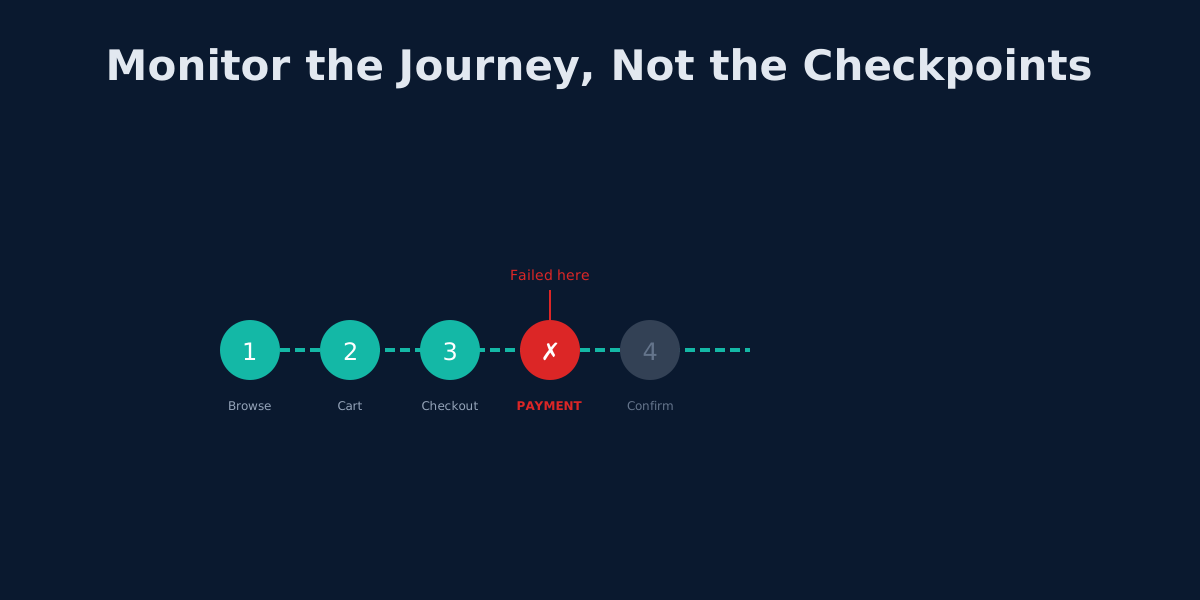
Beyond UptimeRobot: Monitoring Complete User Journeys, Not Just Endpoints
Your API returns 200 OK but users can't check out. Learn why endpoint monitoring creates blind spots and how workflow monitoring fixes them.
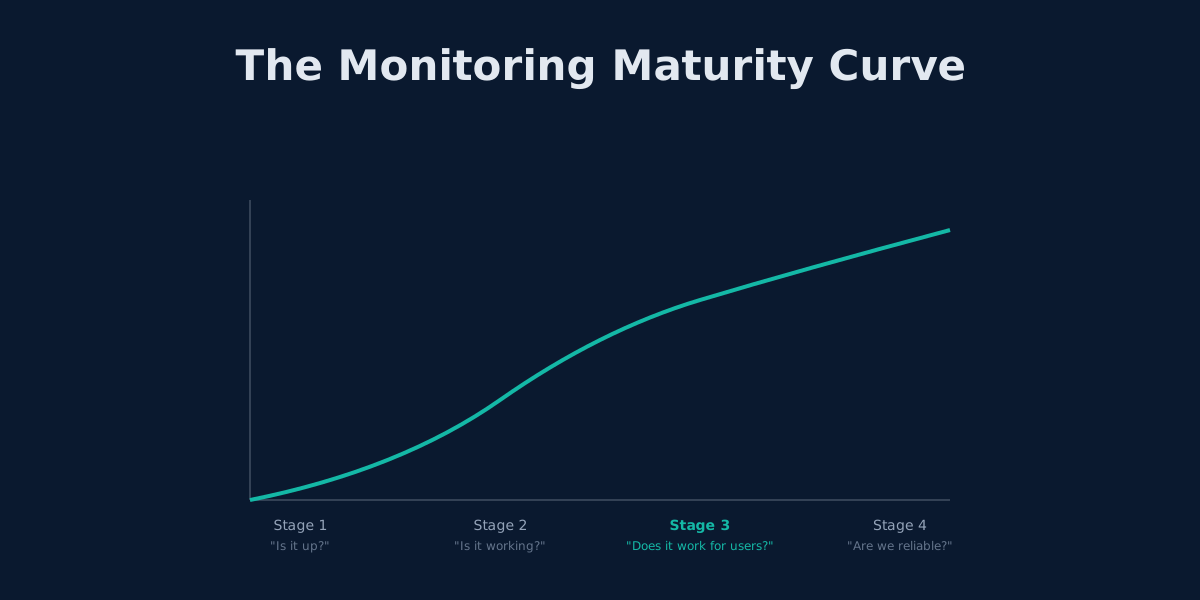
Outgrowing UptimeRobot: When Simple Monitoring Isn't Enough
UptimeRobot works for basic uptime checks. Here's how to tell when you've outgrown it and what comes next.
The 3 AM Page: How to Design Alerting That Lets You Sleep
Alert fatigue is burning out engineering teams. Learn to design wake-up-worthy alerts, implement SLO-based monitoring, and build on-call rotations that don't destroy sleep.